| Livestock Disease Summaries | नेपाली भाषा |
Biology and Control of Ticks
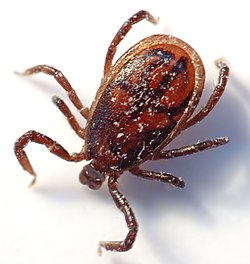
Ticks are large mites and are more closely related to spiders than to insects. Several hundred species of ticks have been described but they can all be divided into two major groups:
| 1) Hard ticks (Ixodid ticks) Have a hard plate or scute on their upper body. |
2) Soft ticks (Argasid ticks) Have an upper body that is like leather instead of a plate. |
|---|---|
 |
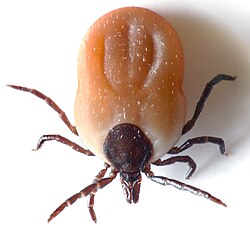 |
| Images courtesy of Wikimedia Commons | |
Ticks go through a complex life cycle with several stages: eggs hatch into larvae, larvae develop into nymphs and nymphs grow into adults. Nymphs are very small and sometimes difficult to see. Engorged adult ticks are usually obvious, as in the image to the right, but you may need to part the hair on the animal to see them. Different types of ticks prefer to attach to different regions of the host so look for them around the ears, neck, belly or genital region.
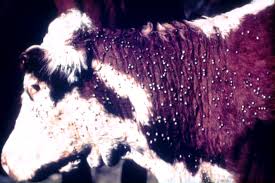
An additional interesting fact about ticks is that for some species all of these developmental stages take place on one mammalian host, while other ticks require multiple different hosts such as rodents, birds and cattle for their development.
Why Ticks are a Problem for Livestock
Ticks cause problems to animals and people in two major ways:
- They carry and transmit a large number of infectious diseases. There are numerous pathogens that are transmitted by ticks. Examples include protozoa that cause babesiosis and anaplasmosis, viruses like tick-borne encephalitis and Crimean-Congo hemorrhagic fever viruses, and bacteria like the one that causes Lyme disease.
- Ticks cause skin irritation and wounding where they feed and a large number of ticks on an animal will result in very poor health. Some ticks also secrete a toxin while they feed that can lead to paralysis.
Tick Removal
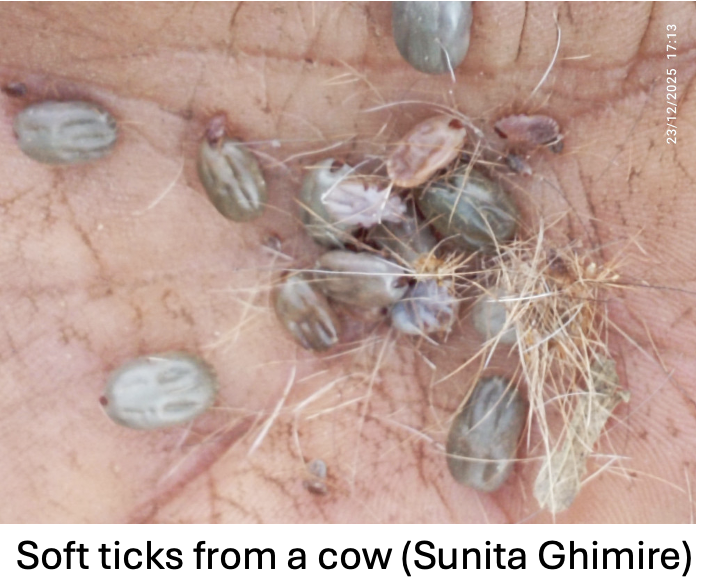
If you see a few ticks on your livestock or yourself, you can remove them manually. Standard procedures for removing a tick are:
- Grasp the tick as close to the skin as possible with a pair of forceps and pull them off using slow, steady pressure. Do not use your fingers to pull ticks off.
- Do not twist the tick off because that could break off its mouth parts and leave them embedded in the skin.
- Avoid crushing the tick during removal as that could release pathogens it is carrying.
Chemical Control of Ticks
Ticks do not lay their eggs on the animal, but on vegetation or soil. When the eggs hatch, the young ticks usually crawl up stems of plants and then jump off onto an animal like a cow to continue their development. The importance of this is that if your animals have ticks, that means that the environment in which they live has ticks and you will need to treat the animals periodically to control the ticks. You cannot control ticks by treating the animals just once. You must treat the animals multiple times to break the tick cycle, usually once each month for several months.
The best way to control ticks on livestock is to treat them periodically with chemicals that kill ticks. There are several ways these chemicals can be applied:
- Spraying
- Pour-on treatment (usually along the neck and back of the animal)
- Use of ear tags or tail tags containing the anti-tick chemical
- Injection or oral treatment
The two drugs most commonly used for killing ticks are permethrin and ivermectin. Both drugs kill ticks by paralyzing them.
- Permethrin is a synthetic form of pyrethrin, a chemical first isolated from chrysanthemum flowers. This drug is applied either as a spray, a pour on, or in the form of ear tags containing the drug.
- Ivermectin is an excellent drug to kill nymph and adult ticks, but is not very effective against larvae. Ivermectin is usually applied by injection or a pour on.
The most important thing to remember in using permethrin or ivermectin is to read the instructions on the bottle! Both drugs come in several different concentrations and formulations, and it is critical that you apply them to animals as the manufacturer describes. If you use too little drug, the ticks will not be killed. If you use too much of the drug, it can be toxic.
A growing problem in treating animals to kill ticks is development of drug resistance when ticks are not killed by the drugs. It is sometimes recommended to alternate treatment with permethrin and ivermectin to try and prevent resistance from developing.
 Back to Index Back to Index |
Send comments to rabowendvm@gmail.com