| Livestock Disease Summaries | नेपाली भाषा |
Stomach Worms (Barber Pole worms) of Goats and Sheep
The barber pole worm is considered the most important parasite of goats and sheep in the world. The scientific name of this worm is Haemonchus contortus. The reason this worm is such a problem is that it sucks large amounts of blood from the animal, resulting in very reduced number of red blood cells, a condition called "anemia". Although this parasite is most commonly a problem for goats and sheep, it can also infest other ruminants such as cattle and deer, and rarely humans.
Adult worms live in the compartment of the ruminant stomach called the abomasum. The lifecycle of this parasite is well known:
- Adult female worms lay huge number of eggs (up to 10,000 eggs/day!). Those eggs are passed out of the animal in feces.
- The worm eggs within feces hatch and develop into larvae. This results in pastures being contaminated with immature worms that crawl up onto grass and other plants.
- Goats or sheep eat plants from the contaminated pasture and swallow the worm larve, which develop to adults within the abomasum.
- Male and female living in the abomasum attach to its lining and start drinking the anima's blood. After they are mature, the male and female worms mate and the female starts laying eggs to start the lifecycle again.
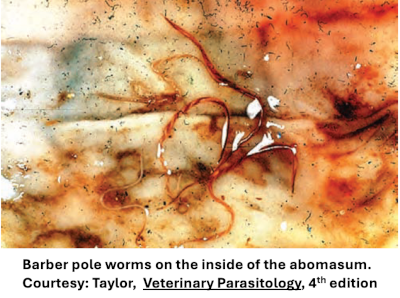
What do these worms look like? Because these worms drink blood, both males and females are pale red in color. The reproductive tract containing eggs of females form pale white stripes their bodies, which is how they get the name barber pole worms. Adult females are 2-3 cm in length and males about half that size. These worms are easy to see by careful examination of the surface of the abomasum, as seen in the image to the right.
Clinical Signs and Diagnosis
Clinical signs in goats or sheep are due to blood loss. The animals membranes (eye, mouth) are pale and they are usually week. Because of loss of blood proteins, another common sign of barber pole infestation is what is called "bottle jaw", where fluid accumulates under the jaw forming a soft but obvious swelling.
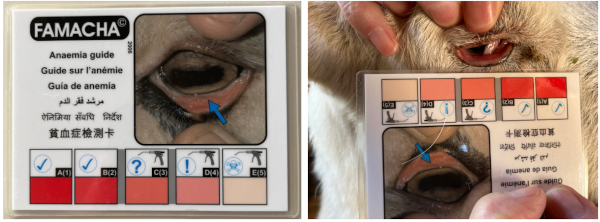
In very severe cases of barber worms, you can simply look at the inside of the animal's eyelids or the gums in their mouths and it will be obvious that they are very pale from blood loss. However, it helps greatly to use what is called a FAMACHA card to get an accurate clinical measurement of blood loss and anemia. A FAMACHA card, as seen below, shows a range different colors of red, from the normal, healthy red color of the inner eyelid to almost white, which indicates severe blood loss. To use a FAMACHA card you pull back the lower eyelid and compare its color with the different colors on the card. If the color of the eyelide is pale, you need to treat that animal with drugs to kill the worms. If the animal is very pale and has bottle jaw, it should also receive fluid therapy.
To confirm a diagnosis of Haemonchus it is good to submit a fecal sample from the animal to a laboratory and ask them to examine the sample for parasite eggs. It is also sometimes good to ask the laboratory to evaluate the animal's blood for anemia.
Treatment
Most commonly-used anti-worm drugs are effective against barber pole worms. These include moxidectin, ivermectin, albendazole, oxfendazole, levamisole and closantel. As usual, read the label on the bottle of medicine and give the correct dose. Animals should be treated once and then treated again about 3 weeks later.
A final thing to mention is that an increasing problem in many parts of the world is the evolution of drug resistance in barber pole worms. If the treatment you give does not seem to work, try a different drug or a combination of drugs.
 Back to Index Back to Index |
Send comments to Richard.Bowen@colostate.edu