| VIVO Pathophysiology | Pregastric Physiology |
Some Like It Hot: Spicey Foods and Molecules
The "hotness" of most spicy foods is due to the chemical capsaicim ("Kap say sn"), which is present in varying concentrations in chili peppers. Capsaicin is the most prominent of is a group of molecules that bind to TRPV1 (transient receptor potential V1), an ion channel type of membrane receptor. This receptor is also stimulated by a variety of physical influences such as temperature and pH.
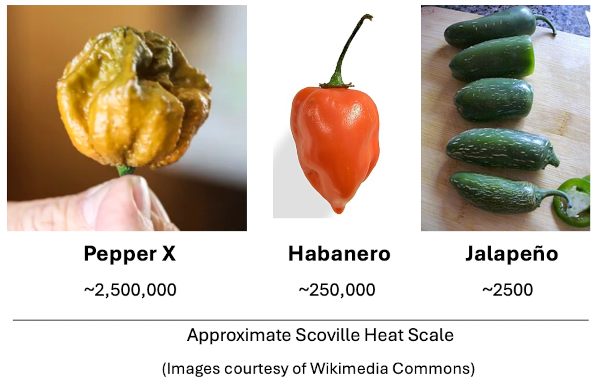
The concentration of capsaicin can be accurately measured by modern analytic methods (high performance liquid chromatography) but the hotness of different peppers is commonly expressed using the Scoville scale. Scoville scale units are determined by the exciting but subjective technique of having brave (masochistic?) human volunteers taste dilutions of chili pepper extracts in a sugar solution and describing just how hot the solution is or how much pain is involved in the tasting. Examples of Scoville grading of three common papers is shown below. Pepper X, a crossbred version of the Carolina Reaper pepper, holds the current record for the hottest chili pepper.
In addition to the importance of capsaicin as a spice, it has been widely used as a painkiller, especially for neuralgia, muscle strains, skin pain, and rheumatoid arthritis. In these conditions, capsaicin is typically administered as a cream applied to the skin. Importantly, capsaicin does not cure any of these conditions. Additionally, some people do not tolerate these treatments well and such therapy should be supervised by a physician.
Chili peppers are not the only possible additives that produce spicy food. Another example is horseradish, which does not contain capsaicin but a volatile molecule called allyl isothiocyanate that is responsible for its nose-clearing properties.
Final note for youngsters: "Some Like It Hot" was a movie released in 1959.
 Pregastric Physiology Pregastric Physiology |
Send comments to Richard.Bowen@colostate.edu