| VIVO Infectious Diseases | Bacterial Diseases of Man and Animals |
Biology of Brucella and An Overview of Brucellosis
Brucella species bacteria are non-motile, Gram-negative coccobacilli. Currently, 12 distinct species of Brucella are recognized, but others are likely to be discovered. The different species are very closely related and, based on DNA sequence analysis, some geneticists have suggested that they might better be described as biovars of a single species that resulted from a series of insertions, deletions and recombinations of an ancestral organism. This genetic diversity extends not only between species, but for strains within a given species. The term "biovar" is frequently used to describe strains within species of Brucella. Biovars are defined by a number of metabolic characteristics such as growth in the presence of thionin or basic fuschin dyes, and by patterns of agglutination by monoclonal antibodies to the organism's lipopolysaccharide.
Brucella have two circular DNA genomes, with sizes of roughly 2.1 and 1.2 Mb. One exception to this statement (there is always and exception) is one of the biovars of B. suis has a single circular genome of about 3.1 Mb.
Another concept that applies to Brucellae and other gram negative bacteria is that of smooth versus rough phenotypes. This refers to the gross appearance of colonies on agar media and is the result of the presence or absence, respectively, of the O-polysacchride in their cell membrane. The classical virulent strains of Brucella – melitensis, abortus and suis – are smooth strains, while B. canis and ovis are rough, even though they are virulent in their natural hosts. The practical importance of smooth versus rough strains is that they react differently to antibodies, as discussed under Diagnostic Testing for Brucellosis
Brucella species have been found to infect almost every vertebrate on planet earth and indeed, species names historically have reflected the major or preferred host for a give species of Brucella. The "big 3" species of Brucella that are major causes of disease in humans and their animal hosts are B. melitensis, B. abortus and B. suis, which primarily infect sheep and goats, cattle, and swine, respectively. This species specificity is far from exclusive. As examples of this, cattle can be infected with B. melitensis, goats can be infected with B. abortus, and, as stated above, humans are quite susceptible to infection with all three of these species.
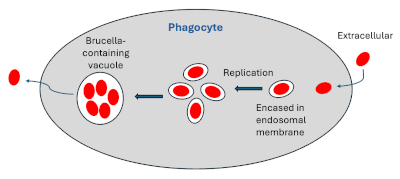
A critically important feature of Brucella is their facultative, intracellular lifestyle, meaning that the can replicate and survive both outside and within cells. Phagocytic cells (macrophages, monocytes, dendritic cells) are the major site for replication and persistence of Brucella within infected cells. Inside such cells, Brucella are further shielded inside what are called Brucella-containing vacuoles. This intracellular localization is important to pathogenesis because living inside phagocytic cells isolates the bacteria from the immune system, allows long-term persistence and chronic infections, and makes treatment with antibiotics difficult.
References
Celli J. The Intracellular Life Cycle of Brucella spp. Microbiol Spectr. 2019; 7:10.1128
de Figueiredo P, Ficht TA, Rice-Ficht A, Rossetti CA, Adams LG. Pathogenesis and immunobiology of brucellosis: review of Brucella-host interactions. Am J Pathol. 2015; 185:1505-17.
 Brucella species and Brucellosis Brucella species and Brucellosis |
Brucellosis in Humans  |
Updated February 2026. Send comments to Richard Bowen: rabowendvm@gmail.com