| VIVO Infectious Disease | Infectious Diseases of Man and Animals |
Bacterial Lipopolysaccharides (Endotoxins)
In the late 1800's the German researcher Richard Pfeiffer was investigating the pathogenesis of cholera and found that injection of heat killed Vibrio cholerae bacteria resulted in fever, shock and death. The method used to heat kill caused the bacteria to lyse, spilling their cytoplasm, so what he was injecting was actually bacterial cell membranes. Since these membranes could not generate a secreted exotoxin like cholera toxin, he deduced that the bacterial cell membranes must contain what he called an "endotoxin". This was the first step in a long saga to characterize the chemistry and biologic properties of Gram-negative bacterial membranes, of which endotoxins are an integral component.
In contrast to Gram-positive bacteria, a key feature of Gram-negative bacteria is a second cell membrane called the "outer membrane". Unlike the inner membrane, which is a familiar phospholipid bilayer, the outer membrane that faces the extracellular environment consists of an inner monolayer of phospholipid and an outer layer of lipopolysaccharide (LPS). The outer memrane provides a robust protective component to the bacteria that aids its survival by blocking entry of such things as detergents and many antibiotics. A schematic depiction of a single LPS molecule is depicted below.
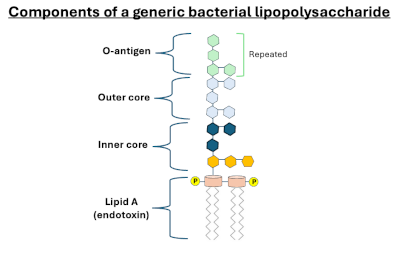
Notice that there are three major domains of a LPS molecule:
- Lipid A: This is a hydrophobic section with fatty acid tails that interacts1 to form the core of the outer membrane. Lipid A functions as the endotoxin of the LPS and provides much of the protective, barrier function of the LPS shield.
- Core oligosaccharide.
- O-antigen: a polysaccharide of variable repeat length that faces away from the bacterium.
The exact structure of LPS varies dramatically among different genera and even species of Gram-negative bacteria. This diversity can be exploited diagnostically by raising antibodies to different types of LPS and using those to identify specific types of bacteria.
LPS molecules are referred to as being amphipathic because they are composed of hydrophobic (Lipid A) and hydrophilic (core and O-antigen sugars. In some cases the O-antigen is missing from LPS due to mutations of the bacterial genome. These differing structures of LPS lead to another common piece of bacterial nomenclature: colonies of bacteria with intact LPS have smooth appearance and are called "smooth strains", while colonies of the same species of bacteria missing O-antigen have a roughened appearance and are called (duh) "rough strains".
In addition to the fascinating biochemistry of LPS, the endotoxin component has profound medical consequences during infections with Gram-negative bacteria. In summary, LPS induces dramatic changes in the host's inate immune reponses, that can be summarized into at least three complex effects:
- Strong stimulation to secrete a battery of cytokines and other mediators that lead to inflammation and ultimately septic shock.
- Activation of complement, release of histamine, dilation of blood vessels and attraction of neutrophils.
- Activation of blood coagulation.
The net result of these activities induced by endotoxin results in inflammation, hemorrhage, intravascular coagulation and ultimately septic shock. As little as 1-2 mg of LPS given intravenously can kill a person. Shock resulting from high blood levels of endotoxin is not rare: it has been estimated that between 5 and 7 million patients worldwide develop this syndrome every year.
Due to the profound effects of even small quantities of endotoxin, the pharmaceutical and biologics industries must be vigilant in screening their projects, especially those made in bacterial fermentation systems, for endotoxin contamination. Several assays have been developed for detection of minute quantities of endotoxin.
References
Farhana A, Khan YS. Biochemistry, Lipopolysaccharide. [Updated 2023 Apr 17]. In: StatPearls [Internet]. Treasure Island (FL): StatPearls Publishing; 2025 Jan-. Available from: https://www.ncbi.nlm.nih.gov/books/NBK554414/
Kellum JA, Ronco C. The role of endotoxin in septic shock. Crit Care. 2023; 27:400.
Raetz CR, Whitfield C. Lipopolysaccharide endotoxins. Annu Rev Biochem. 2002; 71:635-700.
VanOtterloo LM, Trent MS. Microbial Primer: Lipopolysaccharide - a remarkable component of the Gram-negative bacterial surface. Microbiology. 2024; 170:001439.
Zhang G, Meredith TC, Kahne D. On the essentiality of lipopolysaccharide to Gram-negative bacteria. Curr Opin Microbiol. 2013; 16:779-85.
Updated February 2026. Send comments to Richard Bowen: rabowendvm@gmail.com