| VIVO Infectious Diseases | Bacterial Diseases of Man and Animals |
Brucellosis in Other Animals
Marine Mammals
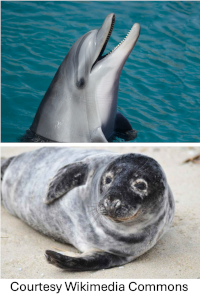
The first isolation of Brucella from a marine mammal was reported in 1994 and the source was an aborted fetus from a bottlenose dolphin. Two species of Brucella are now recognized as infecting marine mammals:
- Brucella ceti predominantly infects cetaceans, including both several species of both toothed whales (e.g., dolphins, porpoises, orcas) and baleen whales.
- Brucella pinnipedialis in the cause of brucellosis in pinnipeds, including a number of species of seals and sea lions.
Based on detection of antibodies it appears that infection of marine mammals is globally distributed. Many of the isolations have been from apparently healthy animals, but infection can clearly cause a variety of diseases in these animals, including abortion, infection of the brain, pneumonia, subcutaneous abscesses and bone infections. In a significant number of cases infection can be lethal. The routes of infection are poorly understood, but it is likely that direct exposure to material from abortions may be involved, as in ruminants.
Both natural and laboratory-acquired infections with B. ceti and B. pinnipedialis have been reported but are far from common. The zoonotic potenial of these species of Brucella appears to be low.
Cats

There is very little information about brucellosis in cats. Serologic testing of stray cats in several countries has revealed seropositive animals, but that is of limited value in understanding this topic. More convincingly, B. abortus was isolated from a cat with pyometra living on a dairy farm with bovine brucellosis in Egypt; in this case the cat likely acquired infection by drinking milk from infected cows. It appears that feline brucellosis is a very rare disease.
Rodents
Laboratory mice are susceptible to infection with several species of Brucella and have been widely used for studies to test efficacy of vaccines and evaluate pathogenesis. Mice are not considered "important" natural hosts for Brucellae, but it must be acknowledged that very few studies have adequately evaluated this statement. Several species have Brucella have been isolated from various rodents around the world, but remain poorly characterized, but there are two well-known species from this genus of bacteria that have been isolated repeatedly from naturally-infected rodents.
- B. microti has been isolated on several occasions from the common voles that had serious systemic disease. It has been isolated also from foxes and wild boars in Europe, but its potential to infect humans and ruminants is not know.
- B. neotommae was originally isolated from a desert woodrat. It was recently implicated as a rare human pathogen and should probably be considered potentially zoonotic.
Fish, Amphibians, and Reptiles
As yet another confirmation of the broad host range of Brucella, B. melitensis has been isolated and its DNA detected from Nile catfish. It this situation, it was speculated that the fish became infected due to dumping of waste from infected ruminants into the river.
"Atyical" species of Brucella have also been isolated from several types of frogs and from a chameleon.
References
El-Tras WF, Tayel AA, Eltholth MM, Guitian J. Brucella infection in fresh water fish: Evidence for natural infection of Nile catfish, Clarias gariepinus, with Brucella melitensis. Vet Microbiol. 2010; 141:321-5.
Grilló MJ, Blasco JM, Gorvel JP, Moriyón I, Moreno E. What have we learned from brucellosis in the mouse model? Vet Res. 2012; 43:29.
Guzmán-Verri C, González-Barrientos R, Hernández-Mora G, Morales JA, Baquero-Calvo E, et al. Brucella ceti and brucellosis in cetaceans. Front Cell Infect Microbiol. 2012; 2:3.
Mühldorfer K, Wibbelt G, Szentiks CA, Fischer D, Scholz HC, et al. The role of 'atypical' Brucella in amphibians: are we facing novel emerging pathogens? J Appl Microbiol. 2017; 122:40-53.
Orsini M, Ianni A, Zinzula L. Brucella ceti and Brucella pinnipedialis genome characterization unveils genetic features that highlight their zoonotic potential. Microbiologyopen. 2022 Oct;11(5):e1329.
Rudolf I, Kejíková R, Kosoy M, Hubálek Z, Mravcová K, et al. Brucella microti and Rodent-Borne Brucellosis: A Neglected Public Health Threat. Zoonoses Public Health. 2025; 72:1-8.
Tonu NS, Hossain A, Islam S, Debnath BK. Brucellosis in Marine Mammals: Meta-Analysis of Prevalence, Infection Patterns, Host Specificity and Zoonotic Potential. Vet Med Sci. 2025; 11:e70557.
Wareth G, Melzer F, El-Diasty M, Schmoock G, Elbauomy E, et al. Isolation of Brucella abortus from a Dog and a Cat Confirms their Biological Role in Re-emergence and Dissemination of Bovine Brucellosis on Dairy Farms. Transbound Emerg Dis. 2017; 64:e27-e30.
 Brucella species and Brucellosis: Introduction and Index Brucella species and Brucellosis: Introduction and Index |
Updated February 2026. Send comments to Richard Bowen: rabowendvm@gmail.com